
You probably grew up hearing the Medusa story as a monster tale — hard stone stare, snakes for hair, end of story. But flip that for a second and she becomes something else entirely: a figure who’s been violated, transformed, weaponized, and in some retellings even protected by the gods. That complicated history is why people — especially women — keep choosing Medusa as a tattoo: it can be fury, grief, protection, or quiet survival all at once. Here I’m sharing different Medusa vibes — tiny, bold, colorful, geometric — and what they can mean when you want your ink to hold a deeper truth.
Small Medusa tattoos
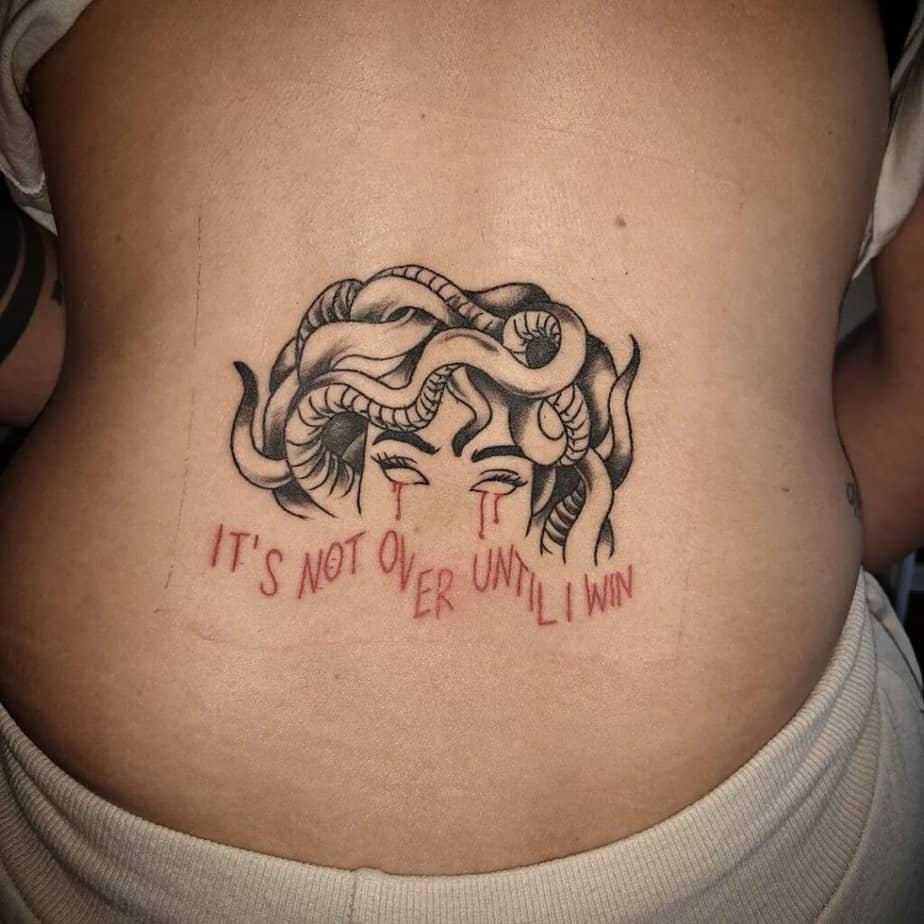
Credit: @mr_ambigous_
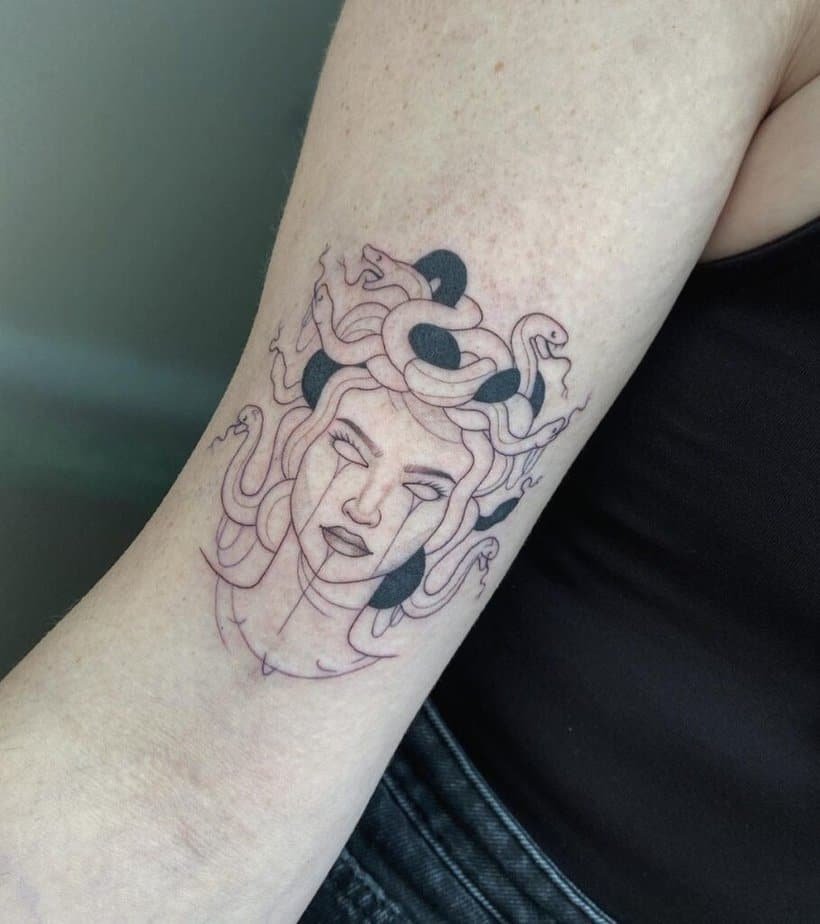
Credit: @megpie.tattoos

Credit: @one_million._tattoos
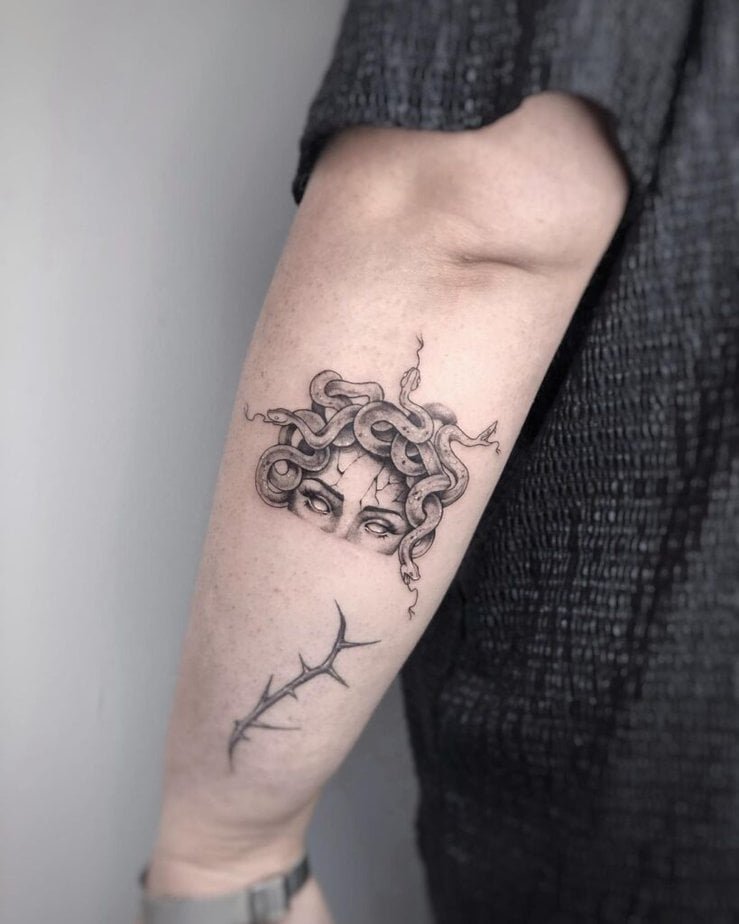
Credit: @greisanastronaut
Picture this: you’re getting coffee, and someone glances at your wrist and pauses because there’s a tiny Medusa curled there. Small Medusa tattoos do a really elegant job of saying more with less. They often keep the snakes tucked close, a few heavy black snakes mixed with lighter, dotty scales, and sometimes a single crack across the face that hints at the stone story without shouting it. What I love is how those tiny details — a tear of blood, a shadow under the cheekbone — make a little portrait feel like a whole life lived.
Turns out minimalist doesn’t mean meaningless. Fine-line work lets artists play with negative space so the face reads stark and still, while the snakes can be almost ornamental. That silent, cracked expression gives the piece an emotional weight that travels with you, even when it’s not the size of a mural.
Why medium hits a sweet spot
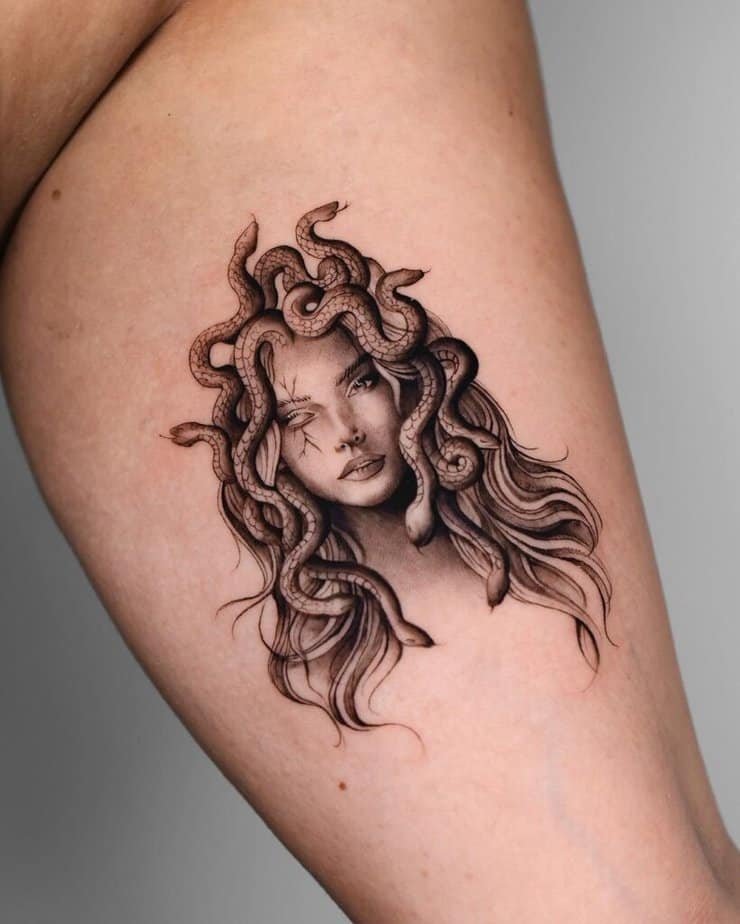
Credit: @ami.tats

Credit: @tracylaguea
Credit: @aliceflemingtattoos
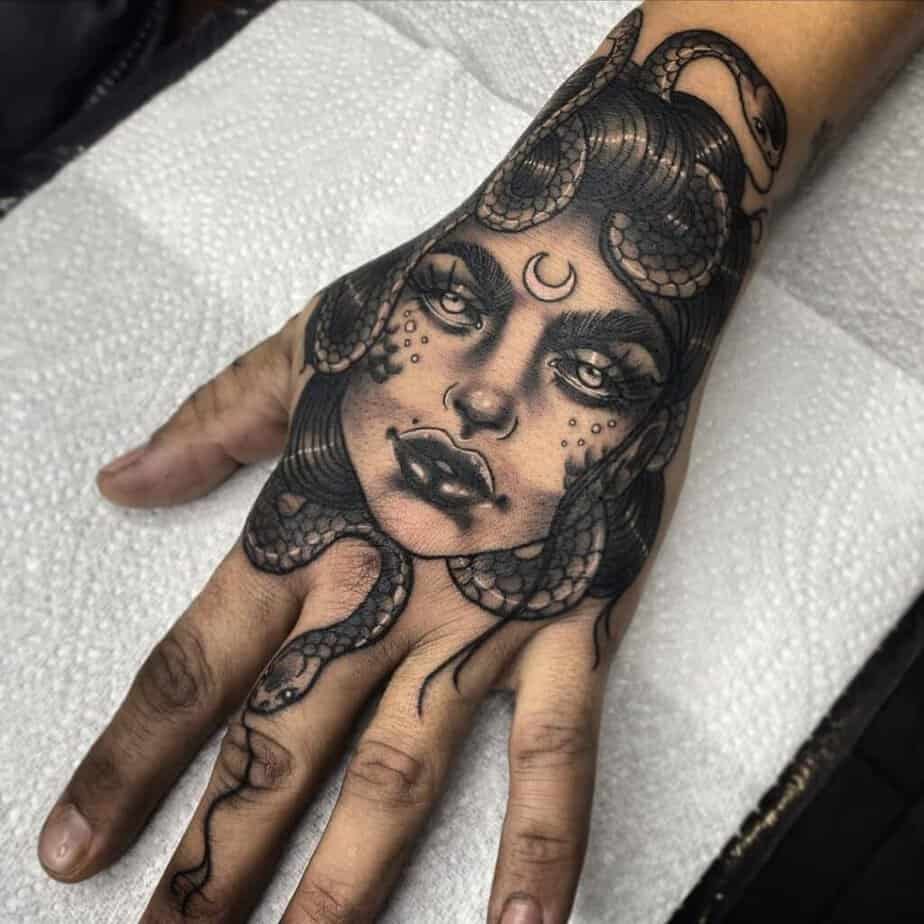
Medium-sized tattoos are the compromise that actually feels intentional. They’re big enough to show realistic shading and expression, but compact enough to sit somewhere you can cover or reveal without commitment drama. In these pieces you often see that beautiful push-and-pull: a realistic face softened by stylized, animated snakes — hair that looks alive while the face seems resigned.
What’s wild is how shading elevates the whole thing. Smooth gradients of gray and black give the features depth, and little touches like scales across a cheek or a delicate crescent moon on the forehead add symbolism without cluttering the composition. If you want a Medusa that reads as portrait and emblem at once, medium is where that balance lives.
Big, dramatic statements
Credit: @annakust_tattoo
Credit: @franveneronitattoo
Credit: @janboedeckertattoo
Credit: @maryarttattoo
Credit: @is_toms

Credit: @kate_loves_ink
Credit: @nocyla.ttt

Credit: @ccyle
Credit: @hayleyploos
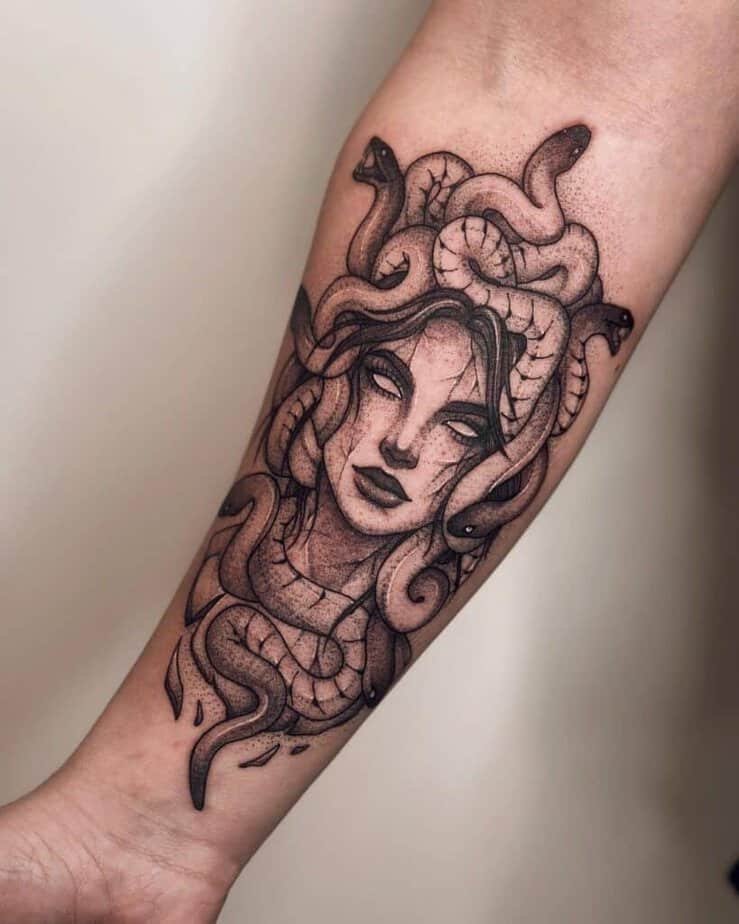
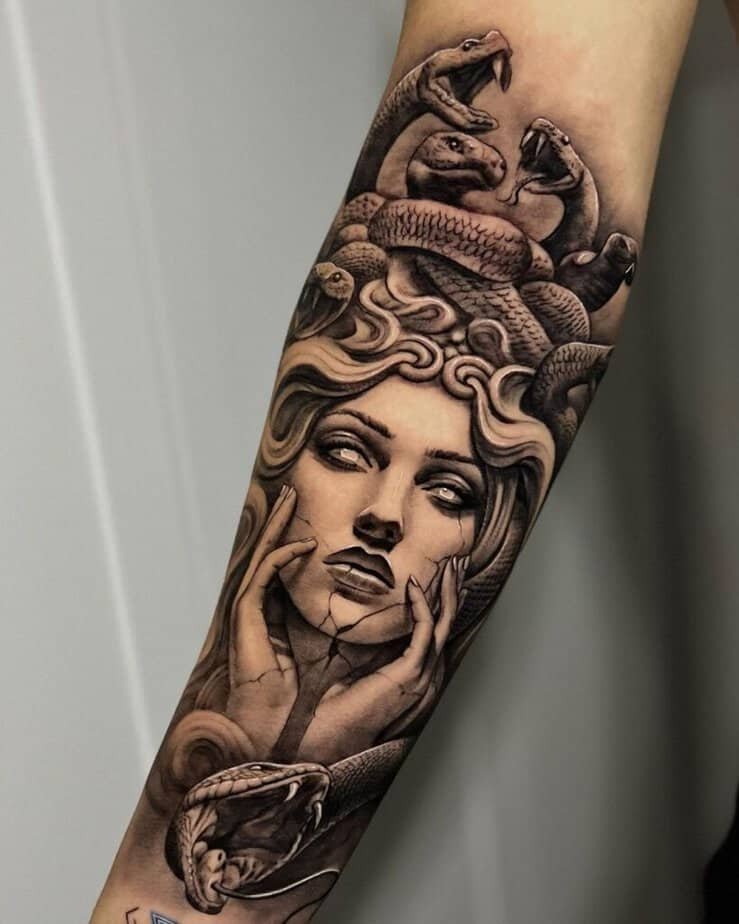
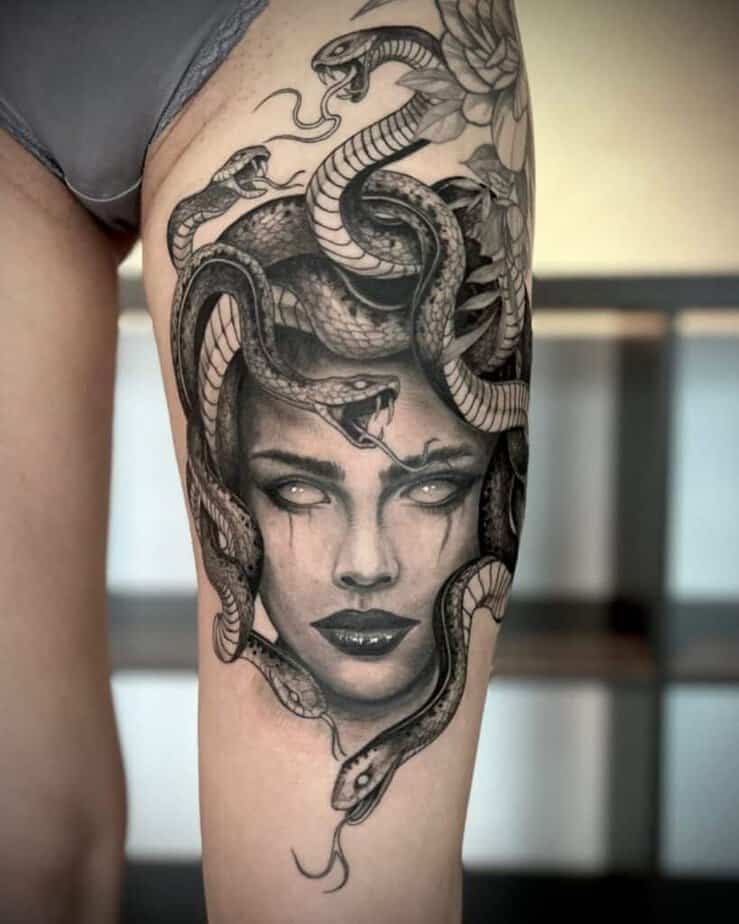
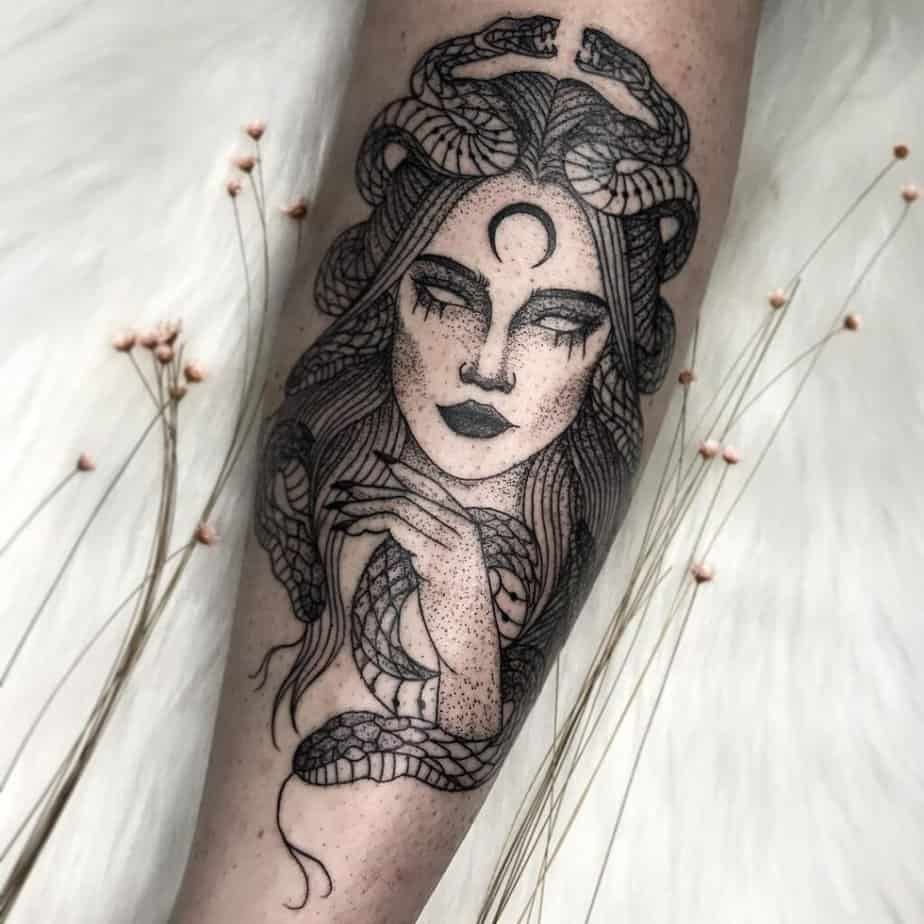
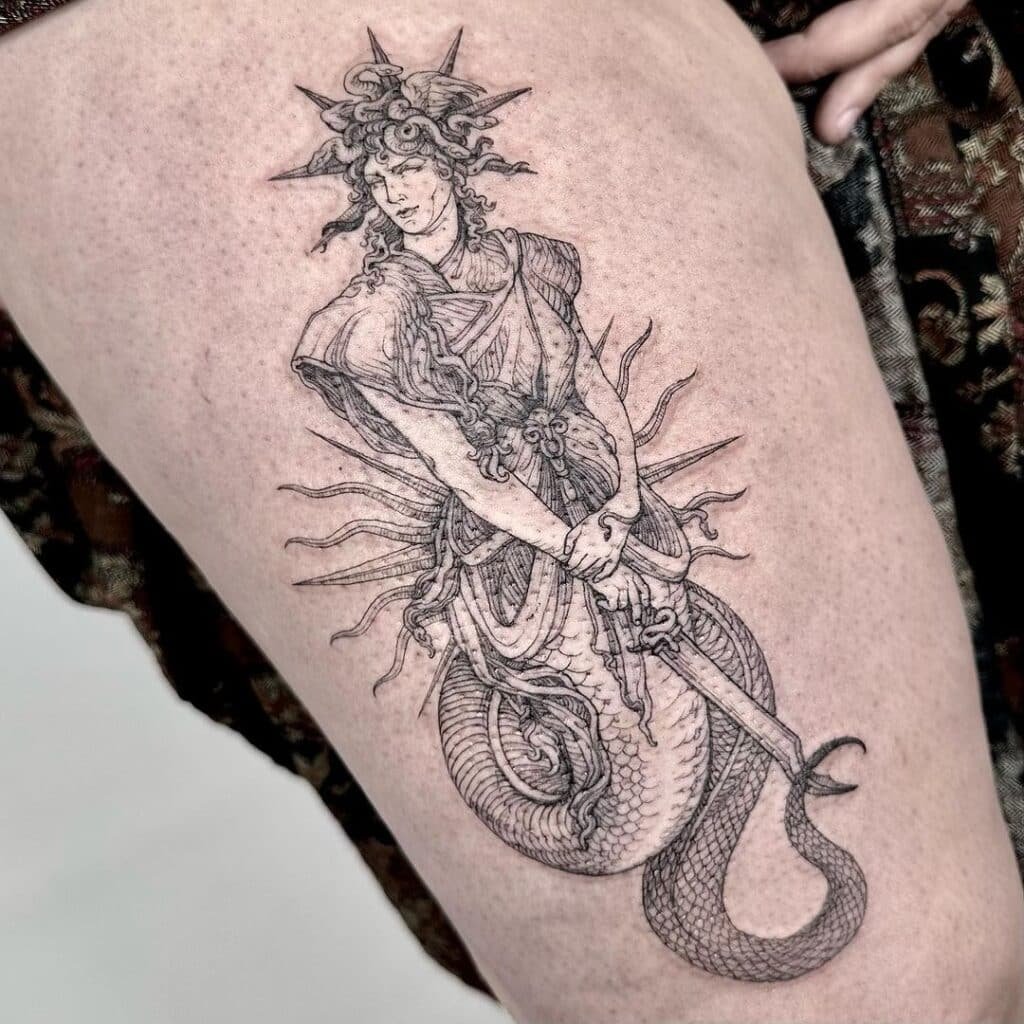
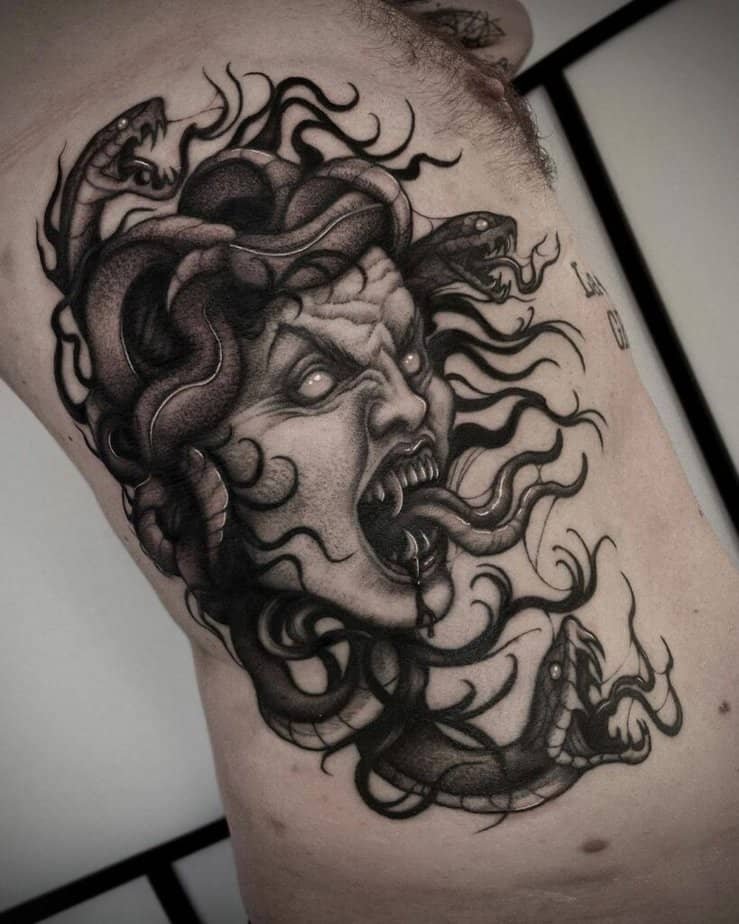
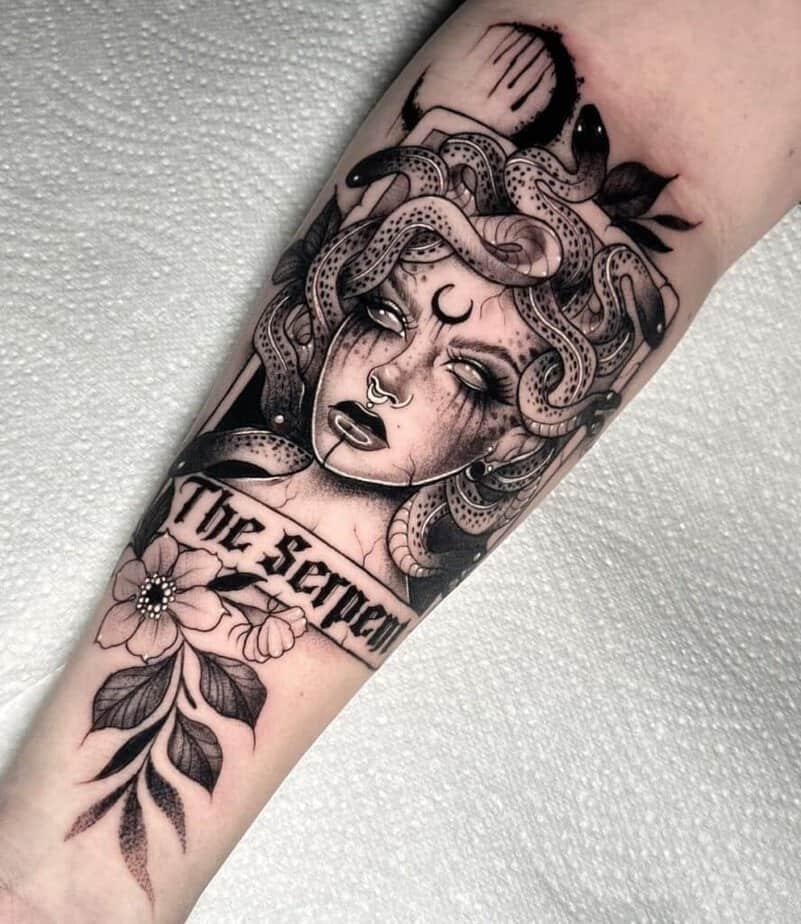
If you want your body to be a canvas that tells the whole story, big Medusa pieces do that with authority. These are the tattoos where every glance finds another detail — a cracked cheek, a curling snake mid-strike, a crown drawn in negative space. Sometimes artists blend realism and traditional flash so you get jagged, graphic snakes alongside soft, shadowed faces.
On that note, size gives you options: a full-figure Medusa with a serpentine tail and a crown reads mythic and theatrical, whereas a chest or back piece that keeps the face central can feel more like a personal talisman. Some designs balance flowers and feminine motifs against deeply black, vengeful shadows — the contrast can make the empowerment feel complicated and human, not cartoonishly fierce. Honestly, if you’re claiming space after something that hurt you, a large piece can be the kind of visible, carved-in reminder that feels righteous.
Medusa with color (little flourishes to go loud)

Credit: @jiro_painter
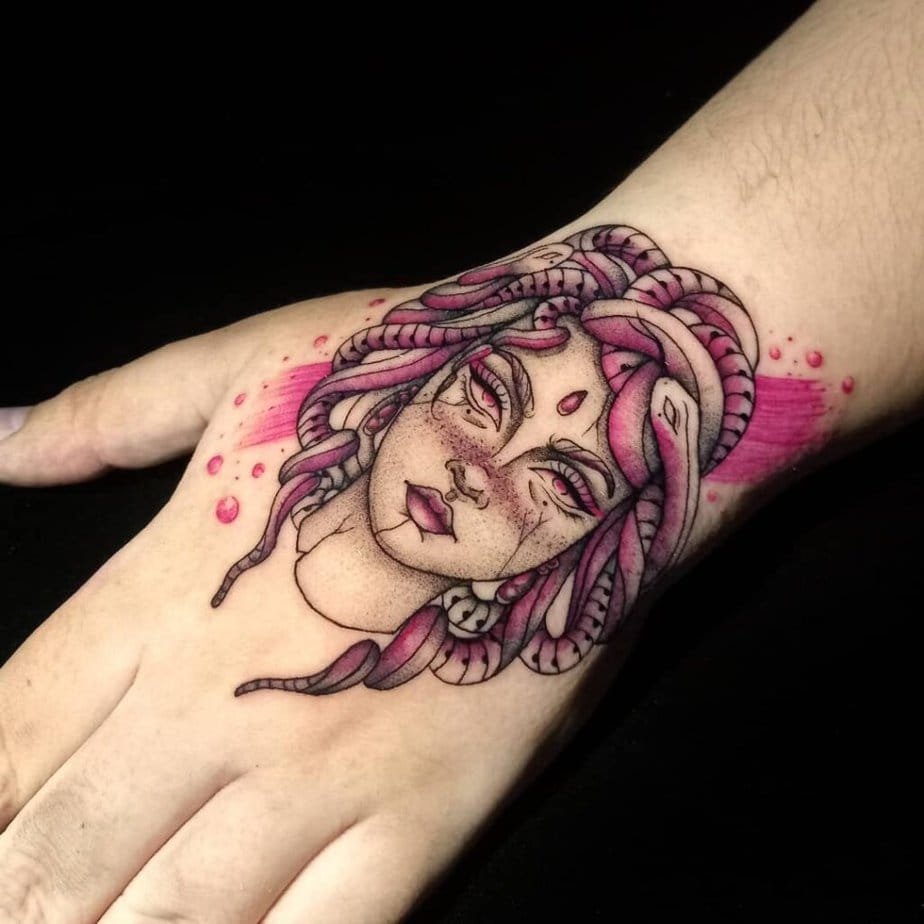
Credit: @gis_tattoo
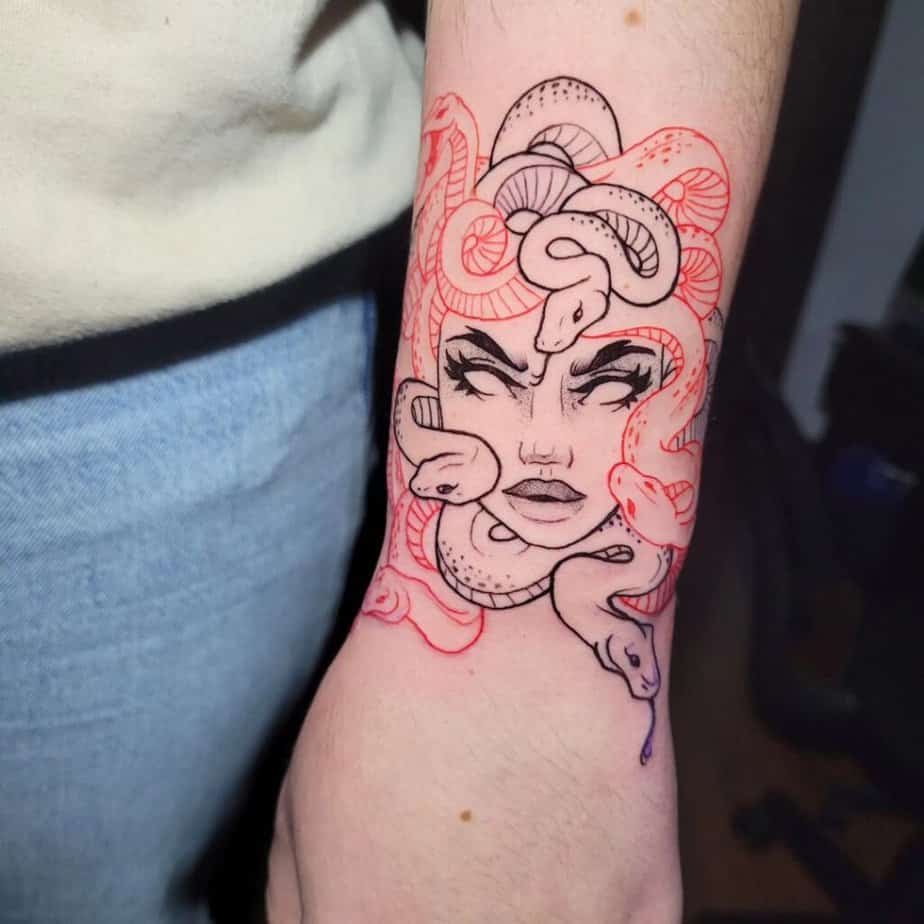
Credit: @y3rku5
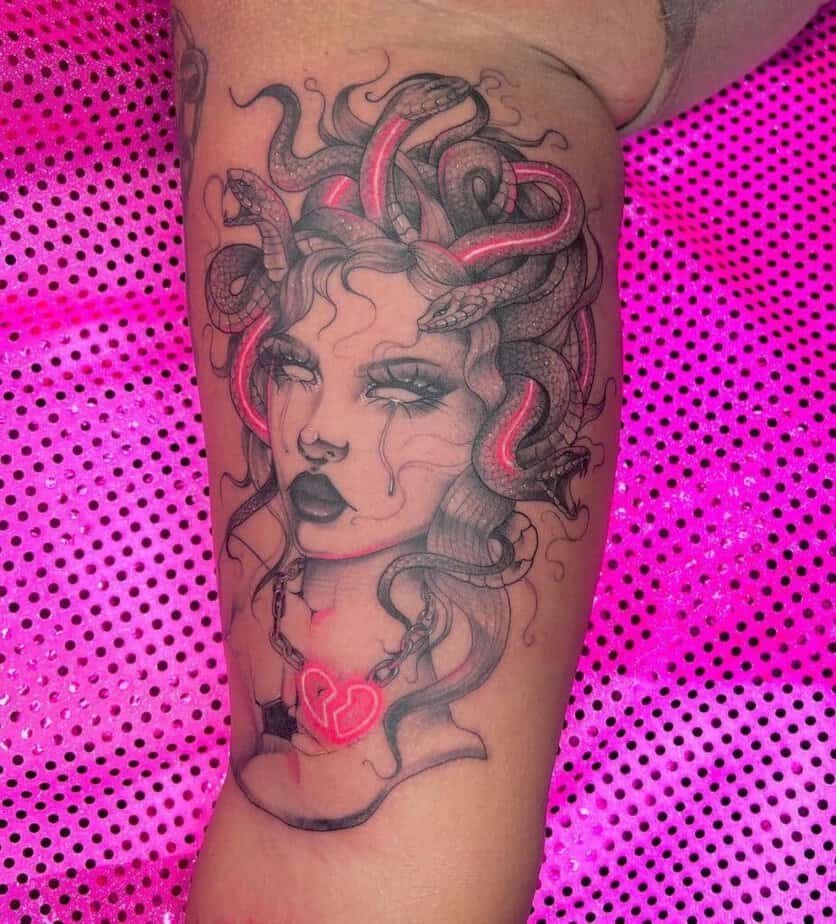
Credit: @tattoosbybethwilde
Colors shift the story. Golden tears, rosy highlights, hot-pink snakes — each hue gives the legend a new voice. A warm wash of yellow and brown can make Medusa feel antique and mournful; a saturated pink woven into black-and-gray makes the piece flirt with softness and defiance at the same time. And when artists use red and black together with fine outlines, the result can feel like an elegant warning.
Get this: neon effects are totally achievable if the artist layers dark foundations and then accents with crisp whites. But the color shouldn’t be an afterthought — the palette needs to serve the vibe you want. Want regal and distant? Try golds and deep blues. Want raw and immediate? A splash of crimson is a powerful shorthand.
Full-color, traditional vibes

Credit: @dusi.2
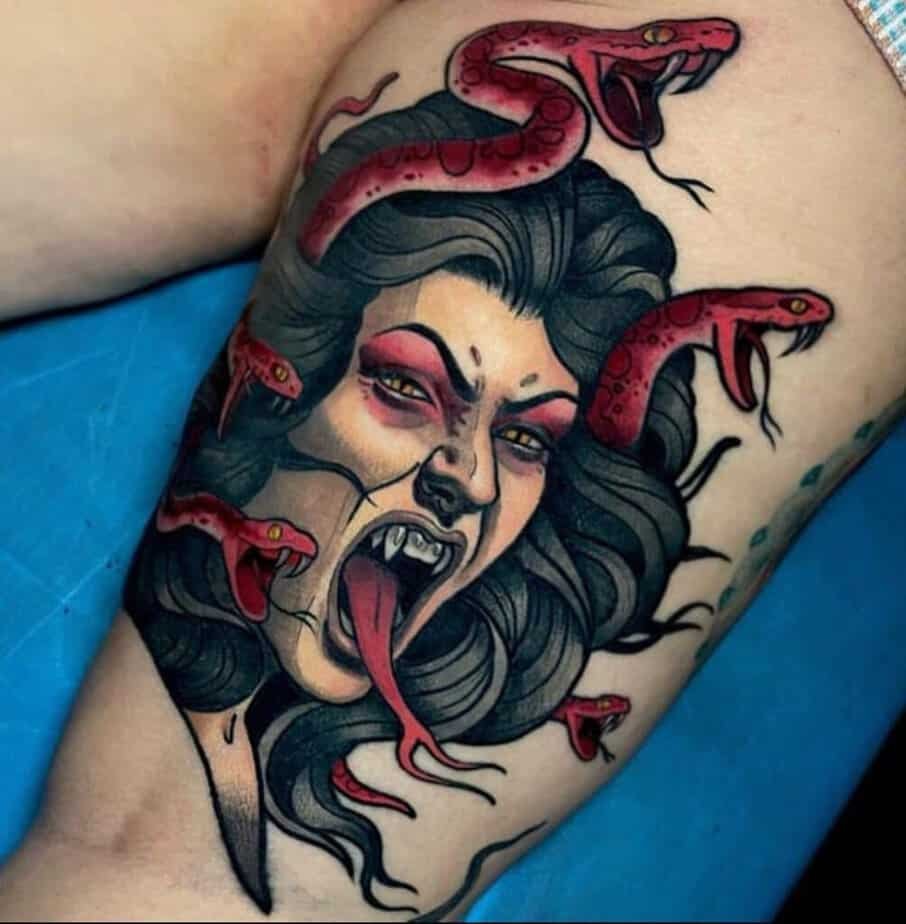
Credit: @remingtontattoo
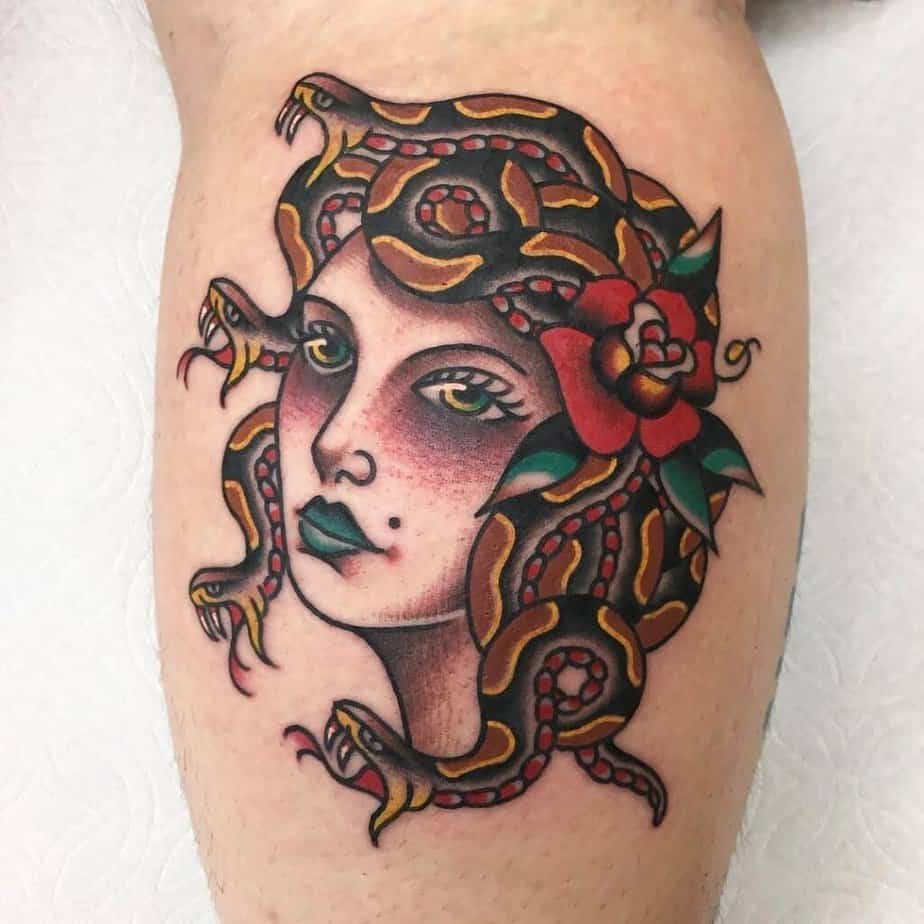
Credit: @harringtontattoo
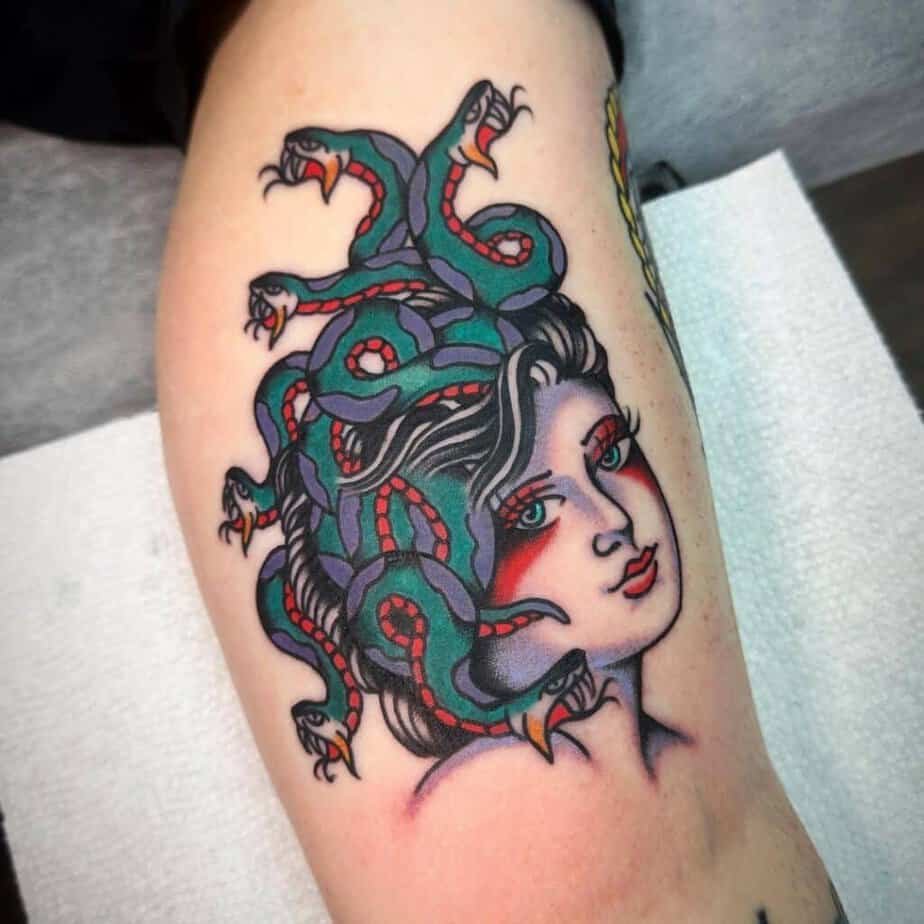
Credit: @cooper.tattoo
If you love the boldness of American traditional work, a fully saturated Medusa can feel like a banner. Thick outlines, chunky color fills, and high-contrast shading make the myth read instantly — fang, forked tongue, and all. Those big color blocks give the piece a theatrical energy; the snakes almost feel like living ribbons around the central portrait.
And if you want Medusa to be more fierce than fragile, this is a great route. The traditional palette holds up over time and keeps the design legible even as skin changes and the years go by. It’s a shout: I survived this, and I wear it loud.
Geometric Medusa (shapes meet story)

Credit: @artes.ttt
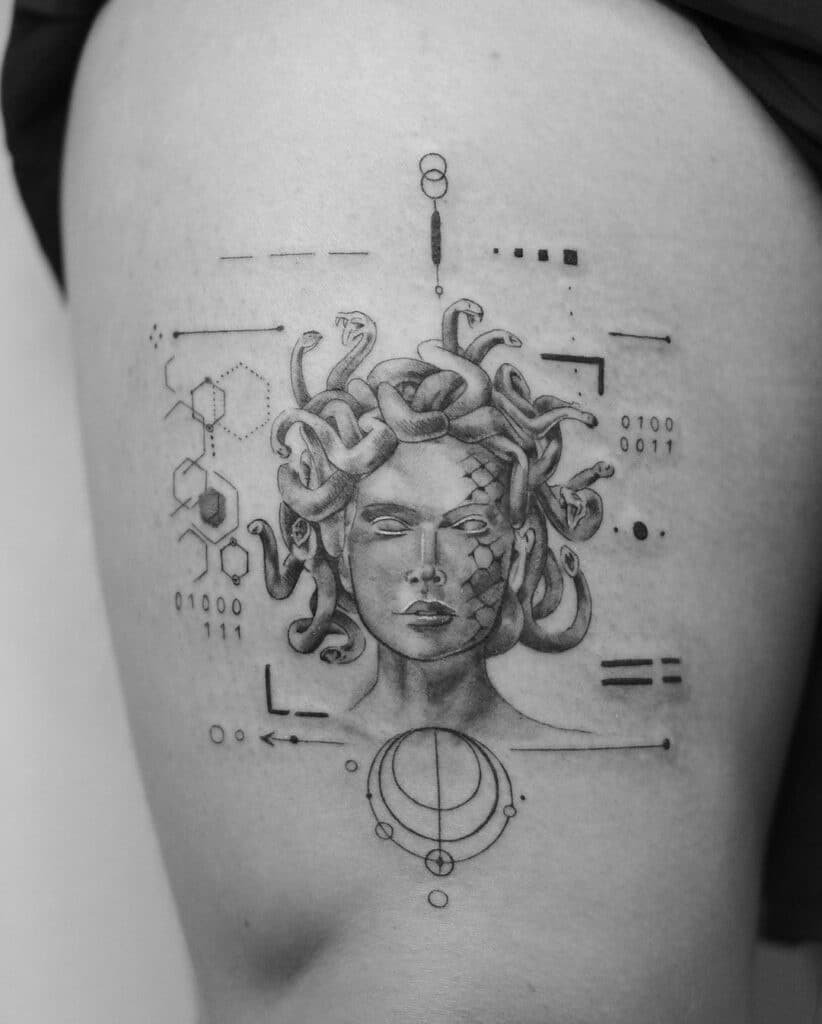
Credit: @vien.tattooist
Geometric Medusa pieces carve the myth into clean lines and deliberate shapes. Circles, triangles, and patterned scales become the vocabulary that frames her face, so even if the piece leans minimal, it feels architected rather than plain. Those scale shapes can be repeated to create movement, or paired with tiny dots and lines to build an almost celestial halo.
Here’s the thing: geometry gives you options to personalize meaning. A ring of circles might read as protection, a fractured polygon can echo the idea of being broken and reassembled, and fine-lined symmetry lends a calm, meditative energy. If you like modern simplicity but want your Medusa to feel intentional and symbolic, geometry is a beautiful translator.
Wrap-Up
You don’t have to pick one single definition for Medusa — she’s roomy enough to be both wounded and powerful, mournful and vindicated. If you’re getting inked as a way to reclaim a story, think about scale and style the same way you’d pick a piece of jewelry: where will it live on your body, and what mood do you want it to carry? I’m always drawn to designs that feel like they can change with the wearer, because healing isn’t a single snapshot.
Also, if you ever want to talk through placement ideas or color combos, I’m here for the late-night mood boards and second-guessing. It’s a lot to put on your skin — might as well make it mean.